
Search engine optimization dominates digital success in 2025, guiding 68 percent of all online experiences that begin with a search engine and channeling over 53 percent of website traffic through organic results.
Google commands 90.48 percent of the global market, processing 16.4 billion searches daily—or roughly 190,000 every second—while driving 63.41 percent of U.S. web referrals.
Marketers harness SEO to capture the first page, where 99 percent of clicks reside, with the top organic spot claiming 27.6 percent alone.
Mobile devices fuel 63 percent of Google’s U.S. organic traffic, and 55 percent of global website visits, demanding seamless experiences that load in under three seconds to prevent 40 percent abandonment rates.
Readers eager to deepen their SEO knowledge and apply it for personal blogs, e-commerce stores, or corporate growth discover here an exhaustive blend of fresh statistics, emerging trends, and practical steps.
Artificial intelligence reshapes strategies, as 86.07 percent of professionals integrate AI tools, with 47 percent of searches featuring AI overviews that rank position one in 87.6 percent of cases.
Businesses witness 1,000 percent more traffic from SEO than organic social media, and 49 percent report it as the highest-ROI channel, often yielding over $22 per dollar invested.
Dive into these insights to craft content that ranks, optimize technical foundations, and leverage voice, video, and local searches for exponential gains.
The Explosive State of SEO in [Year]
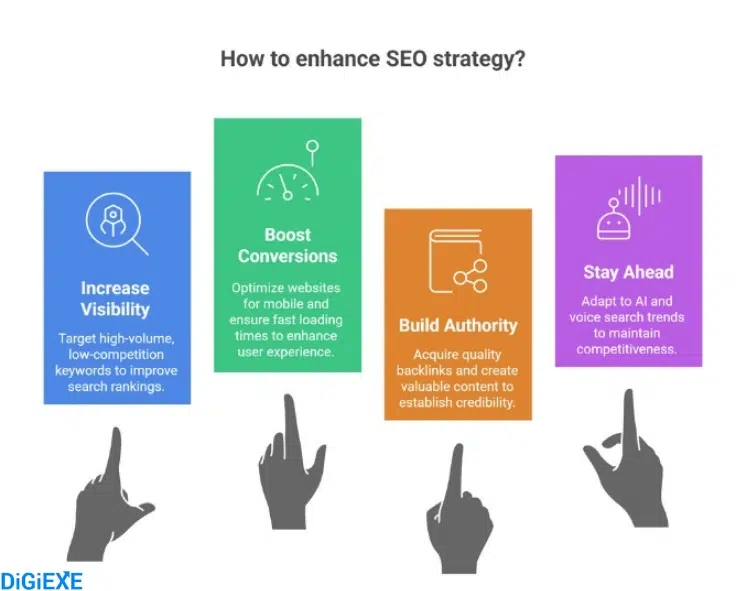
SEO propels industries forward, with the global market valued at $82.3 billion in 2023 and projected to reach $143.9 billion by 2030 at an 8.3 percent compound annual growth rate.
Mobile SEO, a vital subset, grows at 10 percent annually. Search advertising spending climbs to $483.5 billion by 2029, growing 8.86 percent yearly, while Google captures over 70 percent of U.S. traditional search ads in 2026.
Tools like Semrush boast a $1.74 billion market cap with $357 million in trailing revenue, and Ahrefs surpasses $100 million in annual recurring revenue.
Databases expand massively: Semrush indexes 43 trillion backlinks and 25 billion keywords, Ahrefs 35 trillion links and 28 billion keywords.
Ninety-one percent of marketers confirm SEO positively influences performance and goals, especially for mature organizations.
Inbound tactics like SEO generate three in five quality leads, and organic search drives over 40 percent of revenue across sectors.
First-page rankings secure 73 percent of clicks, with top results earning 5 to 14.5 percent more do-follow backlinks monthly from new domains.
Readers start by claiming a Google Business Profile and auditing site speed, instantly tapping local intent in 46 percent of queries and reducing bounces from 37 percent averages.
This table outlines SEO’s ROI across key industries:
| Industry | SEO ROI Percentage | Months to Breakeven |
| Real Estate | 1,389% | 13 |
| Medical Devices | 1,183% | 10 |
| Financial Services | 1,031% | 9 |
| Higher Education | 994% | 13 |
| Oil & Gas | 906% | 10 |
| B2B SaaS | 702% | 7 |
| HVAC Services | 678% | 6 |
| E-commerce | 317% | 16 |
These figures motivate targeted investments, yielding peak returns in years two or three.
Also read about: Future of AI in SEO
Google Dominance and Search Behavior: Navigating the Giant
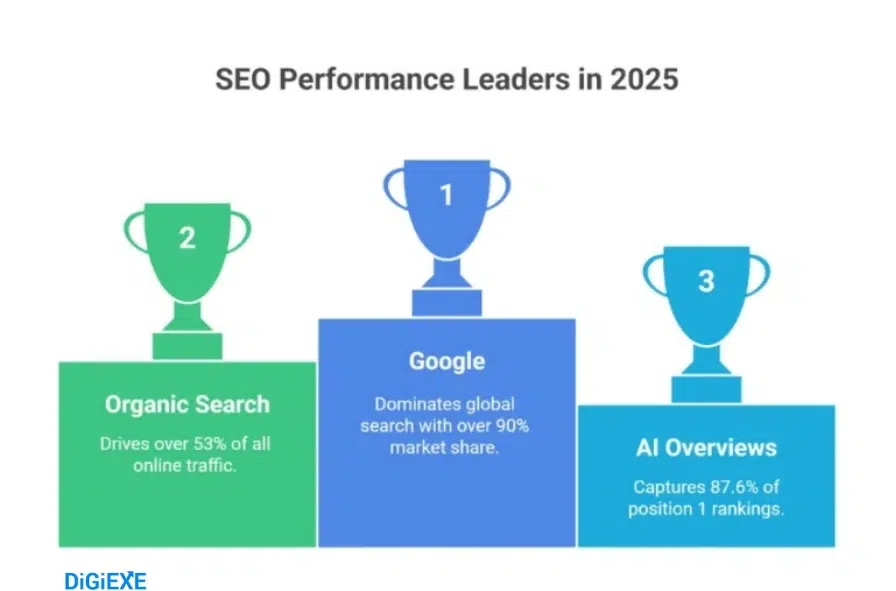
Google holds 81.95 percent market share, with Bing at 10.51 percent, Yahoo 2.67 percent, Yandex 2.42 percent, DuckDuckGo 0.60 percent, and Baidu 0.53 percent—yet Baidu attracts 781 million monthly visits.
Users conduct three to four Google searches daily, with 4.3 billion organic versus 38.9 million paid traffic instances. Seventy-five percent never scroll past page one, and 15 percent of daily queries are entirely new.
AI overviews appear in 30 percent of results, reaching one billion users monthly, and 74 percent of problem-solving queries.
Branded searches comprise over 44 percent, informational 52.65 percent, navigational 32.15 percent, commercial 14.51 percent, and transactional 0.69 percent. Zero-click searches hit 58 to 60 percent in the U.S. and EU.
Optimize by incorporating questions into content, as 8 percent of queries pose them, and target long-tails comprising 70 percent of traffic.
Also read about: How Digiexe Helped Improve SEO for a Website with Low Traffic in 2025?
Keyword Mastery: Research and Optimization Strategies
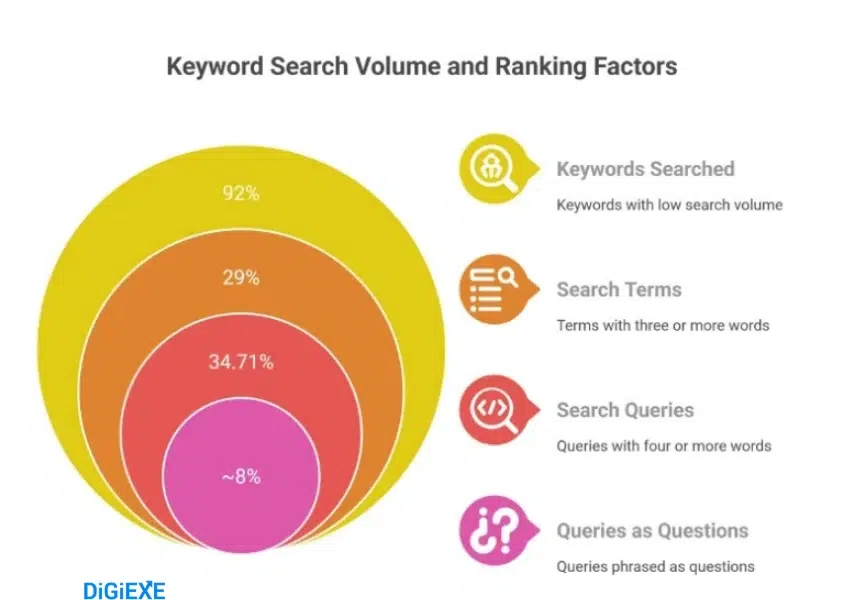
Long-tail keywords drive 70 percent of searches, with 34.71 percent containing four or more words and 29 percent of high-volume terms exceeding 10,000 monthly searches featuring three-plus words.
Top-five organics claim 67 percent of clicks, and URLs with keywords boost click-through rates 45 percent. Ninety-two percent of keywords garner under 10 monthly searches, emphasizing niche focus.
Readers use tools to uncover gaps, creating clusters around core terms for topical authority.
The table below details search intent distribution:
| Intent Type | Percentage of Searches |
| Informational | 52.65% |
| Navigational | 32.15% |
| Commercial | 14.51% |
| Transactional | 0.69% |
Align content to intents for 32.3 percent CTR lifts per position gain.
Content Creation Excellence: Driving Engagement and Links
High-quality content tops effective tactics for 72 percent, with long-form over 1,400 words averaging in top spots. Videos boost inbound links threefold, and posts with them see 157 percent traffic increases.
Seventy-one percent of marketers elevate content priority, projecting $584 billion industry growth by 2027. Blogs attract 97 percent more backlinks, and updating articles yields 146 percent traffic growth.
Craft E-E-A-T-rich pieces, incorporating images in 97 percent of top pages, to earn 77.2 percent more links via depth.
Backlinks and Authority Building: Quality Over Quantity
Backlinks influence rankings significantly, though not top-three per Google analysts, with top pages holding 3.8 times more than positions two to ten.
Active blogs gain 97 percent more links, and high-quality ones outweigh multiples from low-authority sites. Sixty-five percent of pages lack backlinks, but 30 percent of page scores stem from them.
Secure via guest posts or digital PR, monitoring 66 percent broken links for reclamation opportunities.
Local SEO Power: Capturing Nearby Customers
Local queries form 46 percent of Google searches, with 97 billion monthly—37,000 per second.
Twenty-eight percent lead to purchases, 76 percent visit stores same-day, and 88 percent act within 24 hours post-search. “Near me” surges 130 percent since 2020, with 50 percent converting offline.
Claim profiles, gather reviews—three of four top factors review-related—and optimize for 46 percent intent.
This table shows local pack weighting:
| Signal Type | Weighting Percentage |
| GBP Signals | 32% |
| On-Page | 19% |
| Reviews | 16% |
| Links | 11% |
| Behavioral | 8% |
| Citations | 7% |
| Personalization | 6% |
Prioritize steady reviews for sustained rankings.
Mobile Optimization Essentials: Dominating On-the-Go Searches
Mobiles generate 59 percent global traffic, 95 percent of search market via Google, and 27.7 percent CTR for top organics versus 19.3 percent desktop.
Eighty percent of top sites mobile-optimize, and 51 percent of users discover brands here.
Implement responsive design, passing Core Web Vitals—only 33 percent of sites do—to retain 69 percent more buyers via quick answers.
Technical SEO Foundations: Speed, Structure, and Security
Core Web Vitals meet standards in 33 percent of sites, with 11.9 percent passing at least one and 93 percent of those all three.
HTTPS secures 87.7 percent, but 23 percent lack structured data. Titles rewrite in 76 percent of SERPs, up from 61 percent.
Audit via PageSpeed Insights, adding schema for rich snippets enhancing visibility.
Voice Search Revolution: Conversational Queries Rising
Voice comprises 20 percent of searches, one billion monthly, with 27 percent global mobile users and 41 percent U.S. adults daily.
Seventy-five percent of U.S. homes own smart speakers by year-end, and results average 2,312 words.
Target natural language long-tails, structuring data for 50 percent voice-future searches.
Video SEO Strategies: Visual Content That Ranks
Videos feature in 62 percent of searches, boosting first-page odds 53 percent on landings. Short-forms preferred by 73 percent, with 82 percent of traffic video.
YouTube averages 15-minute top videos, drawing two billion reel users monthly on Instagram.
Optimize titles, descriptions, thumbnails; embed to triple links.
E-commerce SEO Tactics: Boosting Sales Online
E-commerce claims 41 percent retail by 2027, potentially $20 trillion by 2040. Smartphones drive 77 percent visits, 68 percent orders; 44 percent consume three to five contents pre-salesperson.
Enhance product pages with reviews—81 percent check Google—and mobile checkout.
AI Integration in SEO: Tools and Overviews
Eighty-six percent adopt AI, 58 percent plan content/SEO uses, 51 percent optimize via it. Overviews in 47 percent searches, 13.14 percent desktop U.S. ChatGPT aids 57 percent experts.
Generate ideas, but human-edit for originality amid 85.5 percent fearing job shifts.
Challenges and Solutions: Overcoming SEO Hurdles
Lack of resources tops issues for 14.9 percent, strategy 12.3 percent, scaling 11.9 percent. Algorithms evolve, competition intensifies.
Invest in tools during sales, document processes for alignment.
This table lists top challenges:
| Challenge | Share of Respondents |
| Lack of Resources | 14.9% |
| Strategy Issues | 12.3% |
| Scaling Processes | 11.9% |
| Alignment with Departments | 10.7% |
| Budget Cuts | 10.5% |
Address via prioritization and training.
Fresh Insights from Quora and Reddit: 2025 Community Discussions
Quora users query AI overviews’ CTR impacts, noting drops but traffic stability via impressions; Reddit’s r/SEO debates Helpful Content Update recoveries, emphasizing user-first rewrites and E-E-A-T signals.
Threads highlight entity optimization beyond keywords, multilingual SEO for global reach, and courses like “SEO 2025 Mastery” for AI-driven tactics.
Discussions warn of zero-click rises, advocate video snippets, and share case studies of 200 percent traffic via schema.
FAQs About SEO Statistics
1. How does AI impact SEO strategies in 2025?
AI impacts SEO by powering overviews in 47 percent of searches and tools for 86 percent of professionals, enabling content optimization and keyword insights that boost rankings, while marketers use it for 51 percent of SERP improvements without replacing human creativity.
2. What role do backlinks play in current rankings?
Backlinks contribute 30 percent to page scores, with top results holding 3.8 times more than lower positions, signaling authority as businesses build via quality sources to enhance visibility and trust signals for algorithms.
3. Why prioritize mobile optimization for SEO?
Mobile optimization prioritizes because devices drive 59 percent of traffic and 63 percent of Google organics, preventing 40 percent abandonments under three-second loads and capturing 27.7 percent higher CTRs on top mobile results.
4. How can local SEO drive business growth?
Local SEO drives growth through 46 percent of queries with intent, leading 28 percent to purchases and 76 percent to same-day visits, as optimized profiles and reviews convert nearby searchers into loyal customers.
5. What future trends shape SEO success?
Trends like voice in 20 percent of searches, video in 82 percent of traffic, and E-E-A-T focus shape success, requiring long-tail targeting, structured data, and AI integration for sustained rankings amid evolving algorithms.
Conclusion: Dominate 2025 with Data-Driven SEO
SEO delivers 1,000 percent more traffic than social, with AI enhancing 86 percent of strategies.
From 68 percent search starts to $143.9 billion markets, prioritize mobile, content, local for ROI exceeding 1,389 percent in top sectors. Implement now for compounding wins.
Sources: eMarketer, PR Newswire, Statista
